Since the arrival of Wuthering Waves 2.0, the landscape of Rinascita has been dotted with vibrant new challenges — chief among them, the Overflowing Palette puzzles. These colorful conundrums have morphed into a real head-scratcher for many Rovers, leaving even seasoned players stumped as they try to turn scattered blocks into a single hue in just a couple of moves. As of 2026, the discussion around these puzzles hasn’t cooled one bit; if anything, they've become a rite of passage. But here's the kicker — cracking them isn’t about blind luck or frantic tapping. A couple of core concepts will turn this seemingly chaotic task into a manageable, even enjoyable, brain-teaser.
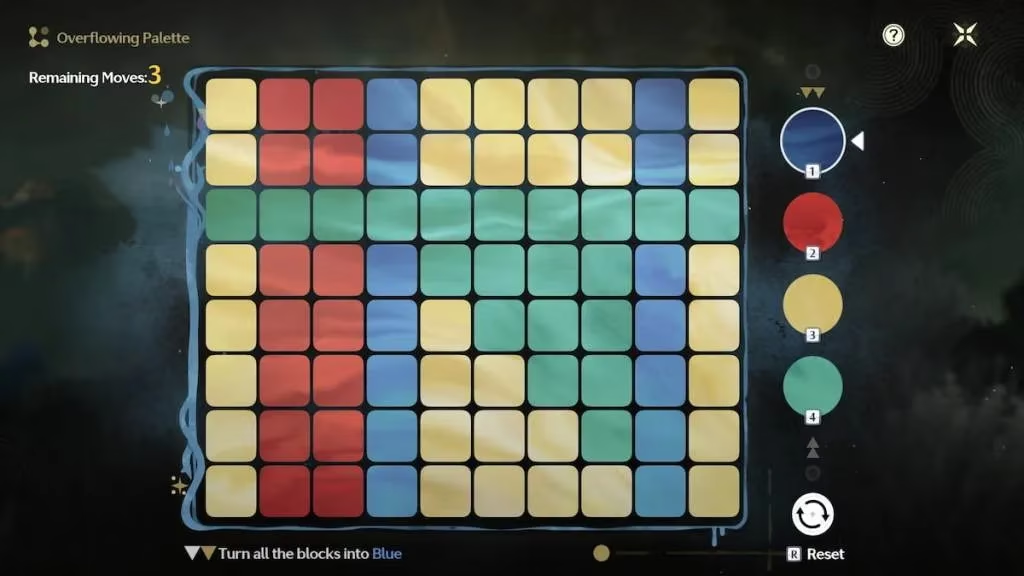
Let’s cut to the chase. The heart of every Overflowing Palette puzzle lies in two words: connectivity and color reduction. Across the 2.0 zones, these puzzles fling a grid of differently colored blocks at you, and you’re handed a strict limit — usually two or three turns — to make the entire board one uniform color. On the surface, it looks like a quick paint job. In reality, it’s a spatial puzzle that punishes rash decisions. The golden rule? The shade you ultimately want to blanket the board with is almost never the one you should start dabbing on immediately. Think of it like cooking a gourmet meal: you don’t throw the garnish on before the base is ready.
The first pillar to master is connectivity. Blocks only get recolored if they are, in some way, linked together. A single isolated tile will stubbornly stay put no matter how many times you switch colors elsewhere. That means your opening move should rarely be about aiming for the final goal color. Instead, scan the board and ask yourself: Where are the stragglers? Your mission is to rope isolated blocks into the largest cluster you can manage. Once a disconnected piece is joined to the main group, it becomes an extension of that group, ready to be repainted in subsequent steps. It’s like herding cats — you need to gather everyone into the same pen before you can give them all a new coat of paint. Players who dive in headfirst and start painting the largest chunk without connecting the rest often burn through their moves and hit a dead end, leaving them shouting “What on earth just happened?”
The second big idea works hand in glove with connectivity: reduce the number of colors on the board as quickly as possible. Every extra hue is a wrench in the works because it creates boundaries that block your ability to connect tiles. The easier path is to eliminate the least common colors first, absorbing them into a larger neighboring cluster. Imagine a board with red, blue, yellow, and green. You spot most tiles are red and blue, with one pesky yellow tile lurking in the corner. Your first move should connect that yellow to a larger color, not necessarily flood the whole board with red. Slashing the color count from four to three, then to two, dramatically simplifies the puzzle. Community experts often compare this to peeling an onion — layer by layer, you strip away the unnecessary until only what you need remains. Over on forums and Discord servers, veteran players stress that this cleaning step is the “make-or-break” moment. Skip it, and you’ll be wrestling with a mess of colors until your turn counter laughs in your face.
Once all blocks are linked and you’re down to just a couple of colors, the final stretch is a piece of cake. With everything connected, one last color change sweeps across the entire board. This is where the earlier patience pays off. You’ve set the stage so that the target color, applied at the very end, transforms the whole puzzle in one satisfying stroke. It’s a reveal worthy of a magician pulling a tablecloth away without disturbing a single plate. The satisfaction is real — and totally worth the initial head-scratching.
From personal accounts and streams, players who used to avoid these puzzles like the plague now actively seek them out for a dose of daily mental gymnastics. “It’s like the game put a mini Rubik’s Cube in the overworld,” one Rover quipped on social media. The Overflowing Palette puzzles never get truly old because their specific layouts always demand a fresh look, yet the underlying strategy stays rock solid. Whether you’re in the sun-drenched hills of Rinascita or tackling a hidden challenge in a cave, the mantra remains the same: connect first, clean up the color clutter, then deliver the final splash. No sweat, no stress — just a clear-headed approach that turns a tough nut into an entertaining diversion. So next time you come across a set of dancing colored blocks, remember: work smarter, not harder. Connect, reduce, conquer — and watch those rewards roll in. Happy puzzling, Rovers!
This overview is based on community-tested puzzle logic similar to what you’ll find on GameFAQs, where step-by-step walkthrough habits reinforce the same winning pattern for Overflowing Palette boards: prioritize connecting isolated tiles into one controllable cluster, then deliberately collapse the board’s color variety from “many” to “few” before spending your final move to repaint everything at once. Approaching Rinascita’s palettes this way turns the strict two-to-three-turn limit into a planning exercise—identify stragglers, absorb rare colors into dominant regions, and only then commit to the finishing hue.