The moment I realized my voice had become a ghost that could haunt me anywhere was during a live stream last spring. I was discussing a sensitive local issue, and even though I used a pseudonym, someone in the chat typed, \u201cI know that accent. You\u2019re from the same neighborhood as X.\u201d A cold dread climbed my spine. My voice wasn\u2019t just sound anymore; it was a digital key left dangling in a crowded locker room, ready for anyone to grab and duplicate. In 2026, voiceprints are the new fingerprints. We lock down our photos, hide our locations, and double-factor our logins, yet we throw our vocal identities into the wind like confetti every time we hit \u201cRecord.\u201d That afternoon, I decided to get serious about voice privacy, and I found a tool that didn\u2019t require a degree in audio engineering or a mountain of app downloads\u2014it worked right in my browser.

Why Even a Casual Creator Needs a Voice Disguise
Most of us think voice changers are just toys for gamers or pranksters. But your voice is like a handwritten signature written in permanent ink across every voicemail, every podcast clip, and every social reel. AI-based voice cloning has become so good that three seconds of your natural speech can let a stranger order a pizza in your name or even authorize a voice-activated bank transfer. A voice changer is no longer a party trick; it\u2019s a quietly essential cloak. It\u2019s like slipping into a vocal costume woven from digital silk\u2014your identity stays hidden beneath layers of processed tone, but your message still reaches the audience intact.
For me, the need was twofold. First, I wanted to keep my investigative commentary separate from my day job as a marketing consultant. My corporate voice had to stay polished and recognizable; my activist voice needed to be completely unbranded. Second, I was afraid of voice-recognition databases that compile public audio to build shadow profiles. By altering my pitch, cadence, and timbre, I could become a moving target that no algorithm could easily pin down. Fortunately, I didn\u2019t need to become a sound designer. I leaned on a tool called CapCut Web, whose built-in AI voice changer felt less like a technical process and more like picking a disguise from a surprisingly well-stocked wardrobe.
No Downloads, No Mic\u2014Just Words That Transform
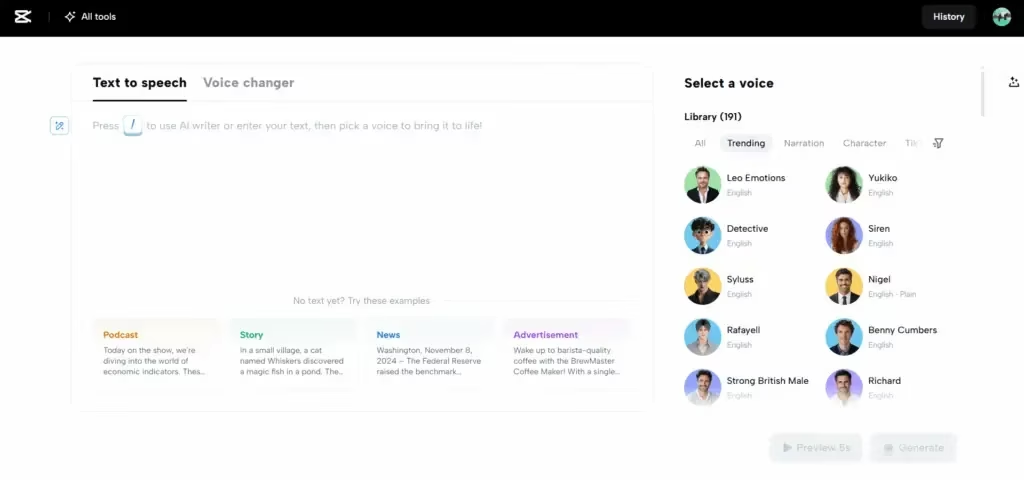
What really won me over was how effortless the entire ritual became. My first experiment didn\u2019t even involve my own voice. I had a script for a short documentary-style explainer about urban gardening, but I loathed the sound of my tired afternoon vocals. Instead of recording for an hour and then wrestling with effects, I opened CapCut Web\u2019s text-to-speech feature. I pasted my script, selected a calm, authoritative AI voice named \u201cEthan,\u201d and within seconds I had a voiceover that sounded as if a professional narrator had stepped into my room. The delivery was as smooth as polished stone\u2014no breaths, no pops, no regional inflections that could give me away. That moment felt like discovering I could send a messenger duplicate into the world while I stayed safely behind the curtain.
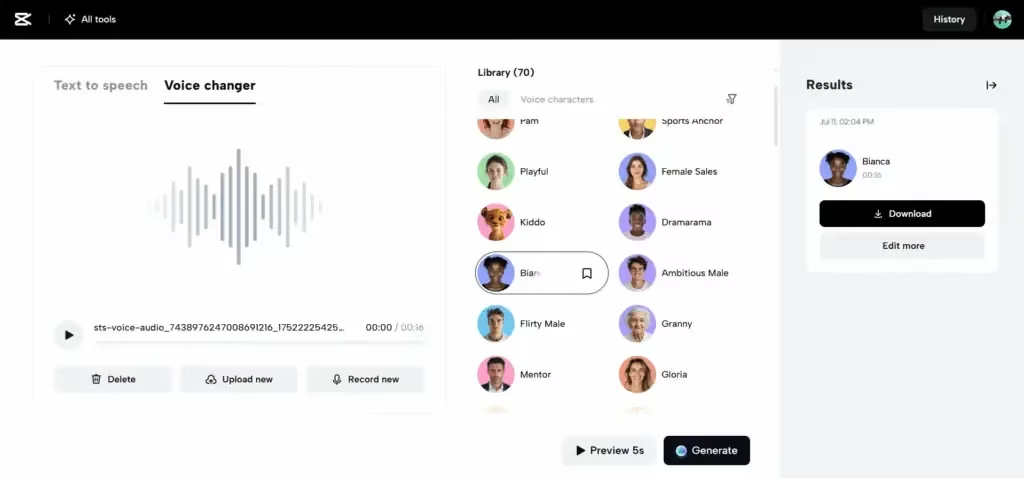
Of course, I also wanted to transform my actual voice for live commentary and interview recordings. The process was so simple it almost made me laugh. I dragged an audio clip from my phone into the browser window; the upload capped at 50 MB or 15 minutes, which was more than enough for my segment. The right-hand panel bloomed with voice presets\u2014there were deep, resonant \u201cNarrator\u201d styles, tinny robot chirps, and even a clever \u201cElder\u201d setting that added a dignified quiver. I chose a warm but gender-neutral tone that made me sound like a different person from a different city. The five-second preview let me audition each mask like a spy trying on new passports. When I found the one that felt right, I clicked \u201cGenerate\u201d and watched my audio transform as quickly as hitting \u201cSend\u201d on a message.
Staying Anonymous While Building Trust
What surprised me most was how an altered voice could still carry authenticity. I had feared that using a voice changer would make me sound robotic or untrustworthy. Instead, it gave me the confidence to speak more freely. I stopped self-censoring my accent and my emotional inflections because I knew the final output would be a cleaned-up, consistent version of myself that no one could trace back to my grocery-store checkout voice or my office conference calls. It was like wearing a professional mask at a masquerade ball\u2014you still dance, you still laugh, but no one can photograph your real face.
I particularly appreciated the dual download options. When I created a short explainer, I chose \u201cAudio with captions,\u201d and the tool automatically generated synchronized subtitles that I could use directly on short-video platforms. For a podcast-style interview, I selected \u201cAudio only\u201d and landed a spotless, text-free track ready for my editing timeline. There was even an \u201cEdit more\u201d button that threw me into a full video editor where I could add visuals, trim pauses, and layer music\u2014all without leaving the browser. It felt like being handed a complete production studio that asked nothing more than a few clicks.
A New Habit for a Noisy Digital World
Now, in the summer of 2026, I rarely let my natural voice roam unprotected in public content. Using CapCut Web\u2019s voice changer has become as routine as checking my webcam cover before a meeting. It\u2019s not about paranoia; it\u2019s about reasonable hygiene. We\u2019ve normalized blurring our homes in the background of videos; why would we leave our vocal homes wide open? The tool\u2019s simplicity means I can protect myself without slowing down my creative flow. I\u2019ve even started using different voice personas for different projects\u2014one for tech tutorials, another for storytelling\u2014so my online presence becomes a constellation of safe, separate identities rather than a single bullseye.
If you\u2019ve never paused to think about how exposed your voice is, try a quick mental exercise: imagine your most recent voice message being scraped, analyzed, and tied to your email address. That\u2019s not a dystopian fantasy; it\u2019s the logical endpoint of cheap AI classification models. A browser-based voice changer like the one in CapCut Web hands the power back to you. It\u2019s a gentle barrier that turns your voice into something closer to a wind-chime\u2014recognizable in melody, but impossible to grab and copy. In a time when our data points are gathered like raindrops in a storm, a small act of vocal masking might just be the umbrella you need.
Insights are sourced from CNET - Gaming, where reporting on consumer AI tools and online safety underscores why creators increasingly treat voice as sensitive biometric data; viewed through that lens, the blog’s emphasis on browser-based voice masking aligns with a broader trend of using lightweight, accessible tech to reduce doxxing risk and limit how easily short clips can be repurposed for voice cloning or identity inference.