Hey everyone, it's your favorite gamer coming at you with some real talk. I've been thinking a lot lately about how games make us feel—not just the hype moments or the epic wins, but those quiet, heavy feelings that stick with you long after you put the controller down. You know the ones. It's 2026, and we've seen so many incredible stories in games, but some themes just keep coming back, hitting harder every time.
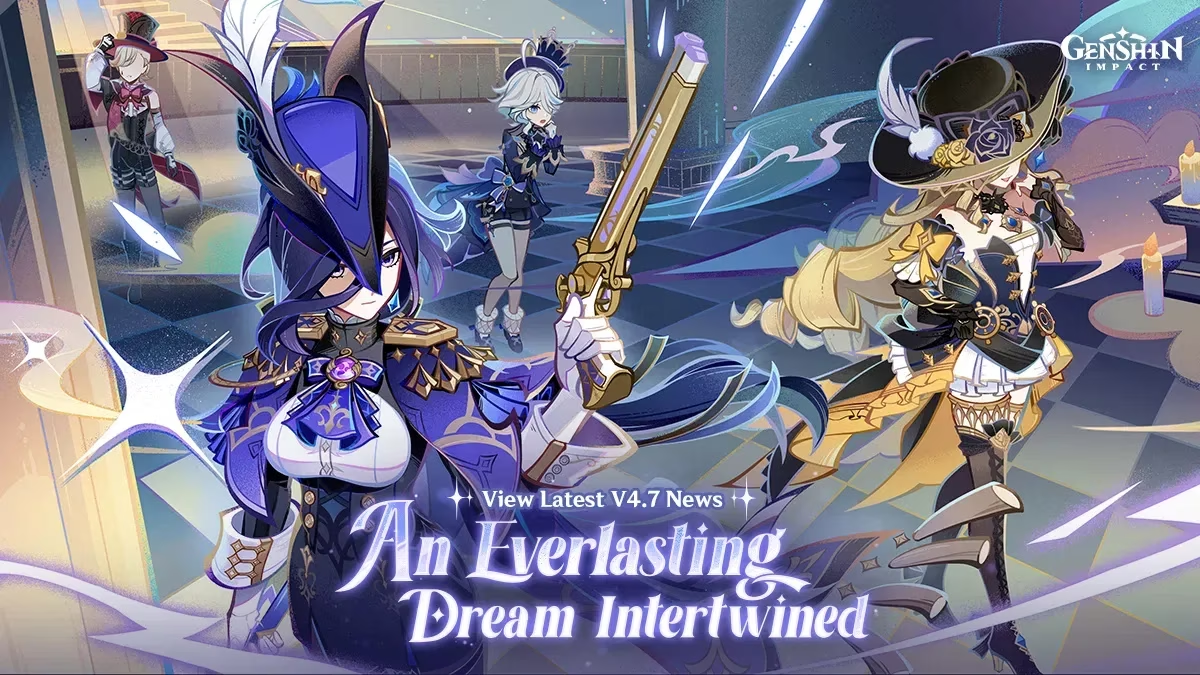
People often feel trapped by the past. I see this echoed in so many of the games I play. It's not just about a backstory; it's the core of a character's entire struggle. Think about it: how many protagonists are literally running from something that happened years ago? It's everywhere! From massive AAA titles to those indie gems that punch way above their weight, this idea of being chained to yesterday is a narrative powerhouse.
Let's break it down. What does being 'trapped by the past' actually look like in a game world? For me, it usually manifests in a few key ways:
-
The Ghost of a Bad Decision: That one choice you made in Chapter 2 that haunts every dialogue option in Chapter 5. 😫
-
The Unfinished Quest: The side mission you failed, the NPC you couldn't save—it sits in your log, a constant reminder.
-
The Memory You Can't Outrun: Flashback sequences that aren't just cutscenes, but gameplay mechanics that distort the present.
All those unresolved regrets... Man, this is where games get personal. A game doesn't just tell you a character has regrets; it makes you feel them. Maybe you chose the 'pragmatic' option that led to a faction being wiped out. Maybe you were too slow in a timed event. That regret becomes your regret. The game's save file might not judge you, but your own memory of playing it does. It's this brilliant, awful magic trick where the player's emotion and the character's arc become one. You're not just watching someone grapple with regret; you're holding the controller, feeling the weight of it in your own hands.
And all those unanswered questions. This is the fuel for a hundred theories on forums and subreddits. "Who really betrayed the guild?" "What was in the sealed letter?" "Why did the city fall?" Games love to dangle mysteries from the past just out of reach. Sometimes they answer them in a sequel or DLC. Sometimes... they don't. And that's almost more powerful. The 'what if' and the 'why' become part of the game's legacy, something the community carries forward, dissecting every line of dialogue and every environmental clue for years. The past isn't just history; it's an active, unsolved puzzle.
Perhaps there’ll come a day when they’ll be set right... This is the hope, right? This is the drive behind every New Game+ run, every 100% completionist grind. We replay games because we believe we can fix it. We can get the 'true' ending, save everyone, find every collectible, and lay every ghost to rest. Game design often supports this! Multiple endings, branching paths, and secret conditions are all built on the promise of resolution. It's the gaming equivalent of wishing for a second chance. We're all chasing that perfect, clean, resolved timeline where every regret is soothed and every question has an answer.
Or maybe they’ll just keep playing out in your dreams. And here's the brutal, beautiful truth. Some things can't be fixed, not even in a game. The most memorable narratives often leave a scar, not a solution. That haunting melody from a fallen companion's theme song pops into your head at random. You'll see a similar landscape in another game and get a pang of nostalgia (or sadness) for a story that ended imperfectly. The unresolved past of these digital worlds bleeds into our own thoughts. It plays on a loop in the back of your mind, just like a recurring dream. You might not be actively playing, but you're still processing, still wondering. That's the sign of a truly impactful story—it won't leave you alone.
So, what's the takeaway from all this? As gamers in 2026, we're not just consumers of content; we're participants in complex emotional journeys. The past, in games, is rarely just a setting. It's an active character, an antagonist, a puzzle, and a mirror. It traps our favorite heroes, and by extension, it traps us in the best possible way—making us care, making us remember, and making us come back for more, forever chasing closure or learning to live with the lack of it. The next time you boot up a story-driven game, pay attention to the ghosts it's asking you to carry. You might be surprised by how heavy they feel, and how long they stay with you. 🎮✨
| Narrative Element | How It Manifests in Gameplay | Player Emotion It Evokes |
|---|---|---|
| Unresolved Regret | Failed quests, permanent character death, moral choices with lasting consequences. | Guilt, a desire to replay and 'fix' mistakes. |
| Unanswered Questions | Hidden lore, ambiguous endings, deliberately vague character motivations. | Curiosity, frustration, community speculation. |
| The Hope for Resolution | New Game+, multiple endings, post-game content, sequel bait. | Determination, optimism, completionist drive. |
| The Cycle of Memory | Recurring flashbacks, leitmotifs in music, environmental storytelling echoes. | Melancholy, nostalgia, haunting attachment. |
In the end, feeling trapped by a game's past isn't a bug—it's a feature. It means the story worked. It got under your skin. And honestly, I wouldn't have it any other way. What's a game that left you haunted by its past? Let me know in the comments—let's be melancholic together! 👇